
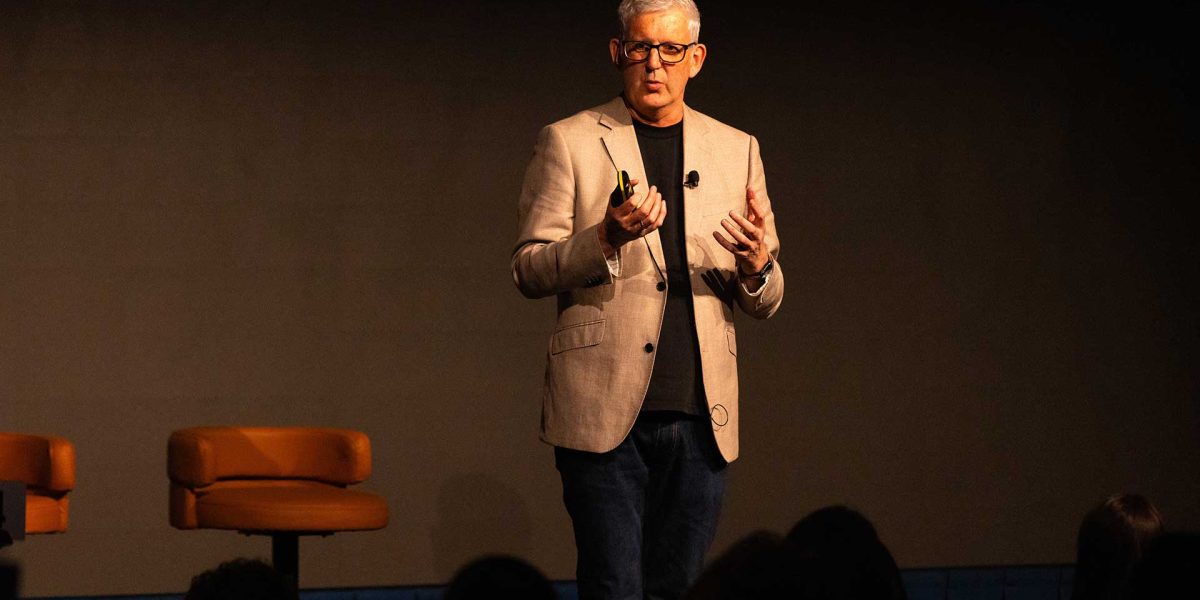
Using AI To Make Yourself Irreplaceable
Andrew Nicol has interviewed 100 New Zealand leaders about AI. His verdict: most of us are strumming a guitar we have never practised, then blaming the guitar.
Andrew Nicol opened with a confession from a Fiji sailing holiday. He wore his prescription sunglasses onto the boat, knowing better. He ducked under the boom, clipped them, and watched them sink. He then dived in wearing a life jacket, knowing better, without first turning the boat into the wind, also knowing better, and spent 15 minutes chasing his own drifting boat. “I knew all of those things because I had experience in them, but I ignored them and it cost me a whole lot of hard work.”
Those little moments of hesitation before a mistake, he calls blinks. “My goal today is to basically give you a bunch of blinks around AI,” he told the room, “so that when you’re about to do hard work, you can think to yourself, maybe AI could do this for me.”
What followed was, by his own warning, a fire hydrant. Nicol, founder and CEO of Preductive, spent last year interviewing 100 senior New Zealand leaders to benchmark AI adoption, and his first finding is blunt: nearly everyone is underusing the tools they already have. The large language models are trained on roughly 200 billion texts, entire books, websites and journals, and run to about a trillion parameters. To make that number mean something: counting to a million takes about 11.4 days; counting to a trillion takes 36,000 years. Yet Gallup reports that seven out of eight people are not getting a significant uplift from AI.
His diagnosis is that people blame the instrument. If he picked up a guitar for the first time, played terribly, then declared “the guitar is broken and stupid”, the audience would rightly point out that the problem was him. Hence his 10-80-10 rule: put 10 per cent of your time into writing good instructions and you get an 80 per cent result, with the final 10 per cent spent tidying up. Skip that first step and the arithmetic inverts. “The time that I put 1 per cent of the time into the instructions is the time that I fight with it for 60 per cent of the time.”
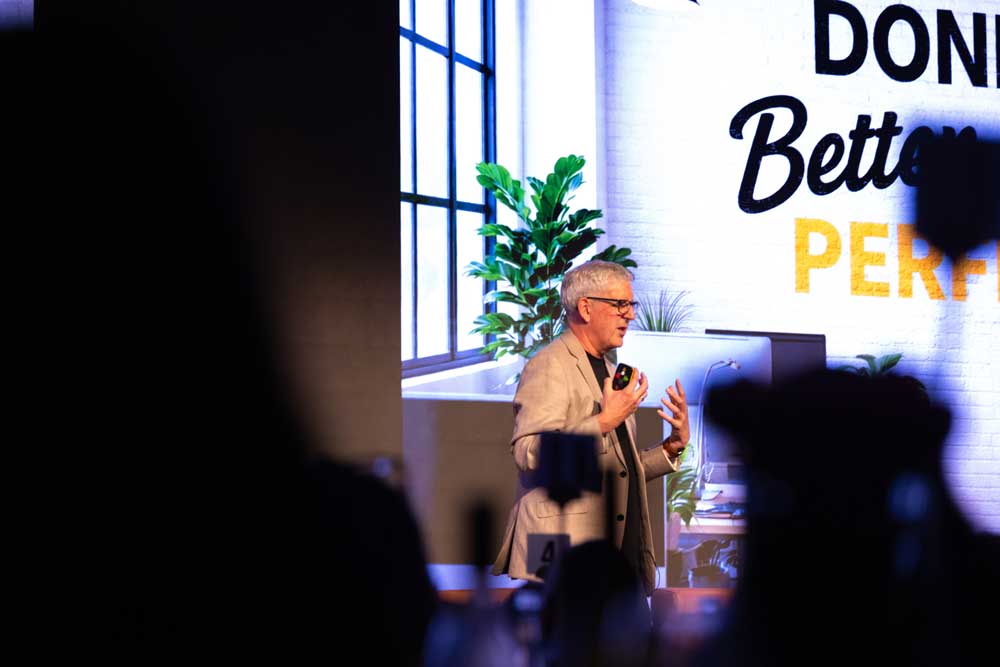
From there the ideas escalated. Custom instructions that teach the model your values, your organisation and your team. Personal shortcuts like TLDR, which converts any wall of text into seven bullet points. Then agents: he has one that drafts emails in his voice, and his firm built a chain of agents that reads the accounts payable inbox, decides whether an email is an invoice, works out which of three companies it belongs to, codes it against historical patterns and lands it in Xero ready for review. He and a developer built a recruitment agent in 15 minutes, and they tell applicants plainly that it is AI. “We actually want to remember that there’s a human being applying for a job on the other side of that.”
He also warned against trusting your own certainty about what AI cannot do. Asked recently whether it could produce documents in a company’s brand, he confidently said no. “I can tell you categorically, three weeks ago, it didn’t do that.” Then he tried it, and found it 80 per cent of the way there. The habit he wants the room to build: “Just because it couldn’t do it three weeks ago doesn’t mean that it can’t do it now.”
Then there is vibe coding, building software with plain language and no code at all. His coffee buddy Ben built 52 prototype apps in a week, including the Nah app: photograph a doughnut, decline it, and it tallies the calories saved and messages your family to applaud your restraint. Nicol himself built a course-scheduling app on the couch, on his phone, in 15 minutes.
His model for all of it is WD-40: water displacement, formula 40, named for the 39 failed attempts that preceded it. “You have to start experimenting. You just have to play. You have to fail. I would say if you’re not cussing at it every now and then, you’re probably not experimenting enough.”
The ending was more sober. Nicol expects unemployment to reach 10 per cent over the next decade, with 15 to 25 year olds hit hardest, and he does not expect the largely white, male AI industry to fix it. He cited a 2024 study spanning 50 years of leadership data that found women leaders more relational, more ethical and more transformational, and challenged the room to lead the way. He recently posted his three adult children a letter with two wishes: be lifelong learners, and love people. “The future needs human beings who provide genuine, authentic connection.” His parting instructions doubled as the letter’s: ask questions continuously, listen intently, hold your beliefs loosely, share your knowledge generously, be authentic, bring joy, laugh a lot.