

Following The Dots Into Yayoi Kusama’s Exploding Mind
You’re in Tokyo, you’ve done teamLab, marvelled at the fish market and hung out with The Strangers rockabilly group at Yoyogi Park. You’ve also heard some Chicago-style blues at an Ebisu bar, sung karaoke in an obscure booth with some other random travellers and petted a cute bundle of fur in a cat café. What other uniquely Japanese things can you do here that you can do absolutely nowhere else on earth?
How about checking out a museum dedicated to the ultimate Japanese artist who not only showcases her brilliant art but gives you an up-close view of what made her so iconic?
The Polka Dot Lady
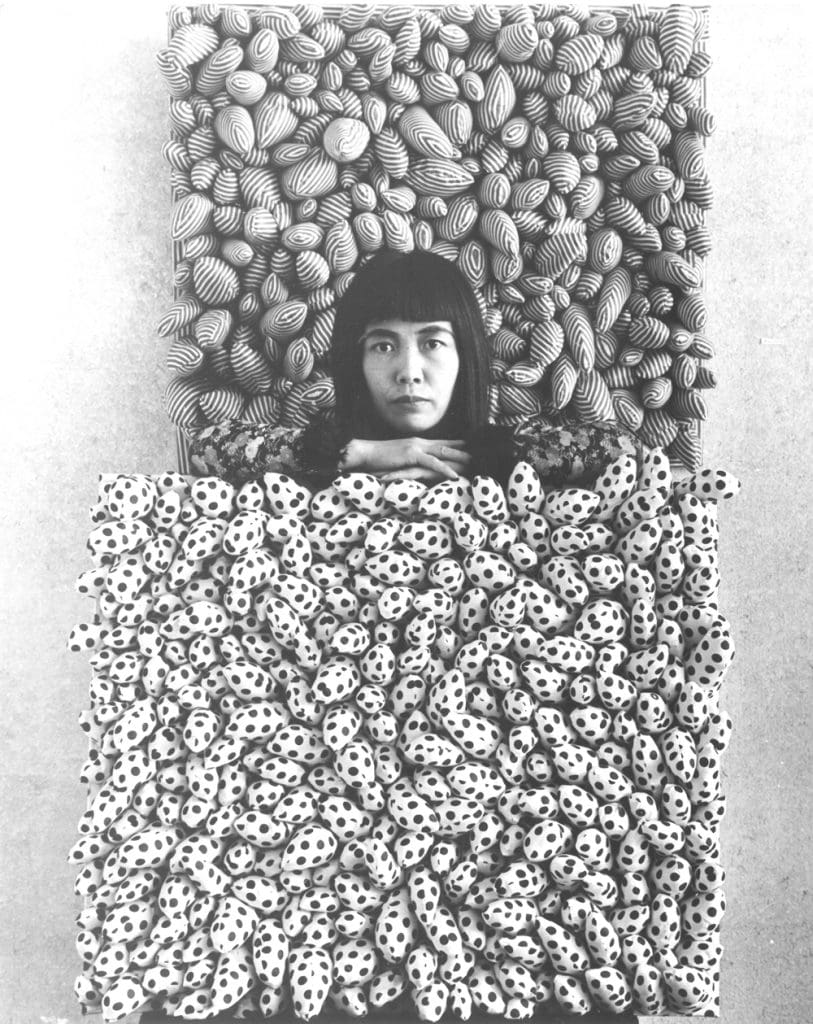
You’ve seen the dots. On a tote bag in Parnell, as a backdrop for some art-house rap poet on TikTok or spray-painted on a pumpkin in your mate’s seriously modern flat. Yayoi Kusama, a.k.a. the “Polka Dot Lady”, is less an artist now and more a global brand – she’s currently in a co-pro with Louis Vuitton, selling $5,000 dotted handbags. The ultimate transformation of radical into commercial. Yayoi won by becoming the system, yet she made her name in New York in the late ‘60s hanging out with Andy Warhol and all the crazies from his Factory including The Velvet Underground.
Back in the Psychedelic Mist, she often exhibited with Warhol and their contemporaries like Claes Oldenburg, Donald Judd and Eva Hesse. Yayoi had a difficult relationship with Warhol, regularly accusing him of copying her use of repetition while there were obviously a lot of similarities in their use of colour too. Who was first to do this or that is difficult to deduce now but it’s safe to say, they probably both heavily influenced each other. Warhol had his 15 minutes of fame back in the ‘60s and ‘70s while Yayoi is still going strong 60 years later.
Yayoi’s Museum
Yayoi Kusama herself is the quintessential Japanese: equal parts brilliant, innovative, quirky and completely insane. Her museum in Tokyo’s business capital of Shinjuku is totally worth the trip as, not only do you get a retrospective of her work/descent into craziness, but it also helps you understand the mind of a genius.
Like much of Tokyo’s buildings, the Yayoi Kusama museum is narrow and tall, several floors high. Inside, it’s a bit cramped but you can follow Yayoi’s work through her ages; starting with the dark sable-toothed phallic nightmare of her youth. As you climb the narrow stairs, each level is brighter, more positive, more insane – yet more pleasing to these ever-widening, more disturbed eyes. Each layer features newer paintings; vast, meticulous, hypnotic nets of colour that feel less like art and more like direct neural uplinks from an endlessly repeating mind. But it isn’t just decoration; it’s a manifestation of a psyche that has stated, for decades, that it uses art as a means to fight off mental collapse.
On the top floor is a replica of Yayoi’s bedroom. You have to queue to get into this room as it can only handle a few visitors at a time. You are also only allowed to be in there for about a minute but it’s enough to get a clear glimpse into Yayoi’s mind.
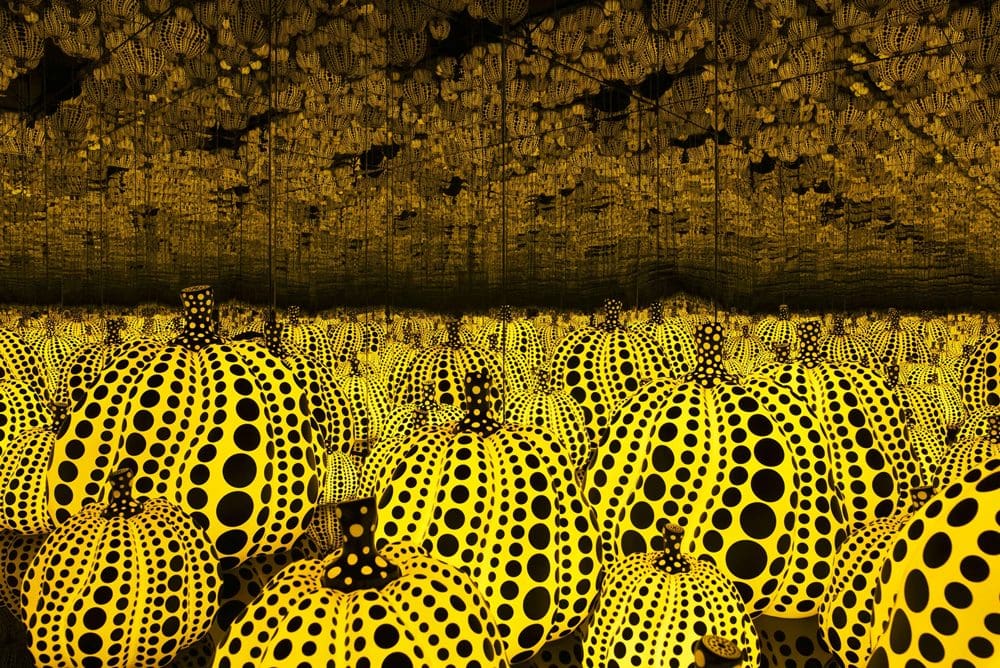
This bedroom is covered in Yayoi’s famous dots – but they’re distorted the further away they are from her bed. To me, it seemed like the whole room was designed to capture that one moment in time when Yayoi had her magical polka dot “vision”. If you look at the walls, ceilings and floor from the doorway, all the dots are elongated. But if you look around you from the bed area, they’re all just normal dot-shapes. The impression I got from being in that room was that one night, Yayoi was sitting on her bed when suddenly, all these coloured dots exploded out of her mind and splashed all over the room. A recording of Yayoi’s madcap singing playing in the background while you are in her bedroom leaves no further questions to be answered. In that moment, I really felt like I understood her mind – what she went through if not the why.
Positively Crazy
Yayoi didn’t choose her dots; they chose her – a visual hallucination that became her life’s work. But instead of an ultimately self-destructive torment like Van Gogh, Kusama’s has been relentlessly productive. She’s built an entire universe from her fixations; even checking herself into the psychiatric institution next door, where she’s lived since the ‘70s – making the asylum both her home and her headquarters. Nuh-uh, that ain’t tragic; that’s a power move!
Getting there
Getting to Yayoi’s museum is not easy by any stretch – but ultimately, I promise it’s worth it as it’s not like any other experience I’ve ever had. First, the logistics, because they’re certainly not designed to encourage the spontaneous! You can’t just rock up on the spur-of-the-moment, you need a ticket booked literally months in advance. I’m not joking; May tickets go on sale at 10am on March 1st and you’ll get a 90-minute slot, so make sure you turn up – on the dot.
Getting there courtesy of Tokyo’s insanely efficient metro system is not too bad; jump on the Tozai Line and it’s a few minutes walk from either Waseda or Kagurazaka Stations. Or you can get off the Oedo Line at Ushigome-Yanagicho Station for an even shorter walk. The whole neighbourhood is pretty studenty with the Waseda University nearby, which means plenty of blaring K-pop, cheap beer, kimchi stew and bookshops to prowl through. Make a day of it, let Yayoi get inside your mind too.