
Miraka Davies on Building & Maintaining Resilience
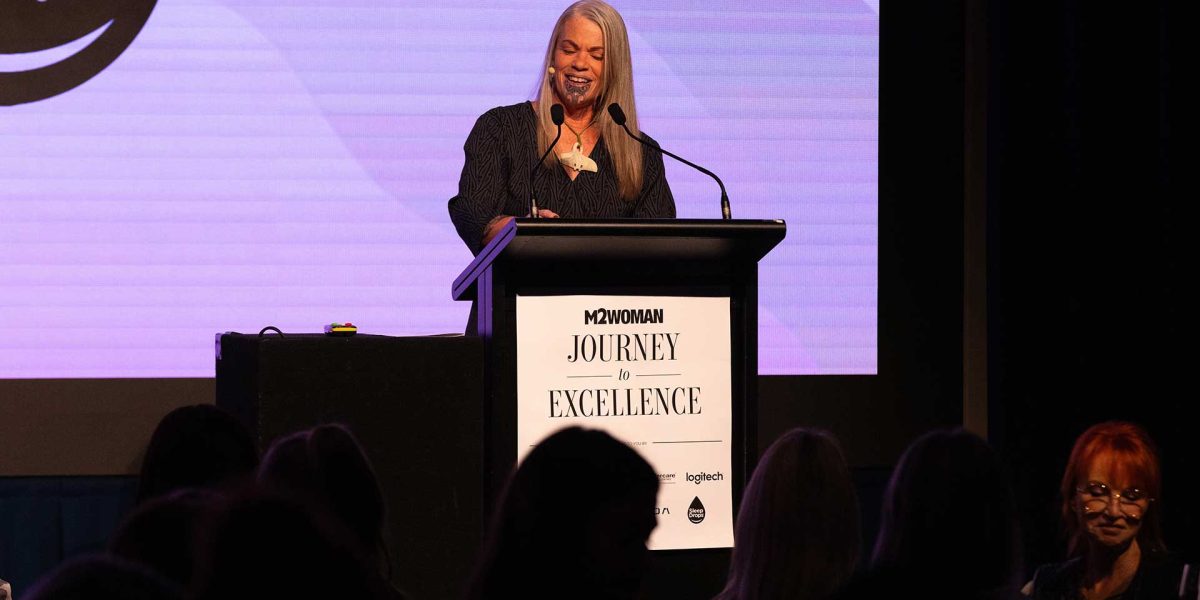
Miraka Davies opened the Journey To Excellence stage with a waiata and a rebrand, then spent half an hour demonstrating that resilience has nothing to do with keeping it together.
The first thing Miraka Davies did as keynote speaker was introduce herself, which was awkward, because she was also the MC. “This is the weirdest thing ever to do, you guys, introduce yourself on stage,” she admitted, before taking a breath, switching hats and doing what she does: singing a waiata, then explaining why.
The song, she told the room, was written by a grandfather searching for his mokopuna, a grandchild who, we can infer, had died. The grandfather finds a way to be okay by keeping his mokopuna close: in sleep, in dreams. It was a deliberate place to start. “Resilience doesn’t mean I’ve always got everything under control,” she said. “Resilience is in being able to bounce back when we’re not okay. Resilience means knowing that it’s okay to not be okay, and to sit in that when we need to. That is true resilience, in my opinion.”
Davies, billed in the programme as the “Deadpool of Keynotes”, proceeded to make the case with her own biography. She is from Aotea Great Barrier Island and lives in Rotorua. She is 52, has ADHD, three children, eight mokopuna and a name she claimed only four years ago. Born Rochelle Anne Davies and known for most of her life as Shelley, she took the name Miraka after a year of total immersion te reo Māori study. “It’s not personal. It’s not multiple personalities. It’s just a rebrand.”
The name is not random. Miraka means milk, and it belonged to her ancestor Raihi Miraka, the last tūpuna in her whānau to wear a moko kauae, known by that name because of her very pale skin. Davies, who has spent her life “feeling not Māori enough” on two counts, being “super white” and not having her reo, found the symmetry irresistible. “I cannot tell you how powerful I feel in and of myself, knowing that now I have the way to articulate who I am using the language of who I am.”
Much of the talk was about reframing. She grew up believing she was overly sensitive; she now understands she is highly empathetic. She thought she was flighty; she is adaptable. This is not spin, she argued, it is working self-knowledge. When a copywriting client hires her (she wrote the current Māori electoral roll campaign, and she is “not cheap, just saying”), she can tell them exactly how to get the best out of her: collaboratively, in the moment, and not buried under background noise before being left alone for a week. She once turned up to therapy asking her psychologist to help her feel her emotions less. What she learned instead was the opposite. “Emotions are data sets. They’re giving us information. They’re neither good nor bad.”
There was plenty here that the average keynote speaker would leave out. Raised in a conservative Christian religion, she had never tasted alcohol or coffee, or sworn out loud, until she was 38. She has been married twice, divorced twice and widowed once (“do the maths, doesn’t work out”): her first husband died during their divorce proceedings. Her partner of 14 years, a Māori carver, began as a friends-with-benefits arrangement that contradicted everything her upbringing had taught her. When he eventually suggested they stop before it ruined the friendship, she declined. “I know I’ve got a heart that is big and strong and can handle breaking. I’m going to be all in.” They now share a mortgage, which she rates as rather more of a commitment than a marriage.
The through-line was vulnerability, which she framed as a structural property rather than a soft one. “Vulnerability makes us flexible. It helps us move with the wind and the tides. When we’re not flexible, we are breakable.” Learning her reo, having her culture inked into her skin, leaving the church her whānau had known for five generations: all vulnerable, all acts of strength.
She closed with an admission. Preparing for the day, she had felt like a fraud, because the past few weeks had been rough. “There hasn’t been a single day that I haven’t cried, probably multiple times.” She is a mother of adult children, she explained, which means living with the fallout of choices you no longer get to make. But she decided the tears disqualified nothing. Resilience, she reminded the room, is knowing that not being okay “is a moment and it will pass”. Knowing who you are is where the power comes from.
Key Takeaways
1. Resilience is recovery, not composure. Being resilient does not mean always coping. It means being able to come back, and giving yourself permission to not be okay in the meantime.
2. Know your own operating manual. Davies tells clients exactly how she works best. Understanding what makes you powerful, and what challenges you, turns self-awareness into a professional asset.
3. Interrogate your labels. “Overly sensitive” became highly empathetic; “flighty” became adaptable. The traits you have been criticised for may be strengths wearing bad PR.
4. Treat emotions as data. They are neither good nor bad. Ask what you are feeling, why, and what meaning you are giving it, then decide what to do with the information.
5. Vulnerability is flexibility. Rigid things break. Doing the exposed, uncomfortable thing, whether learning a language, claiming a name or standing on a stage, is what builds the capacity to bend.