

Order in Chaos – Kristy Brown’s Journey to Leading One of ANZ’s Largest Tech Partners.
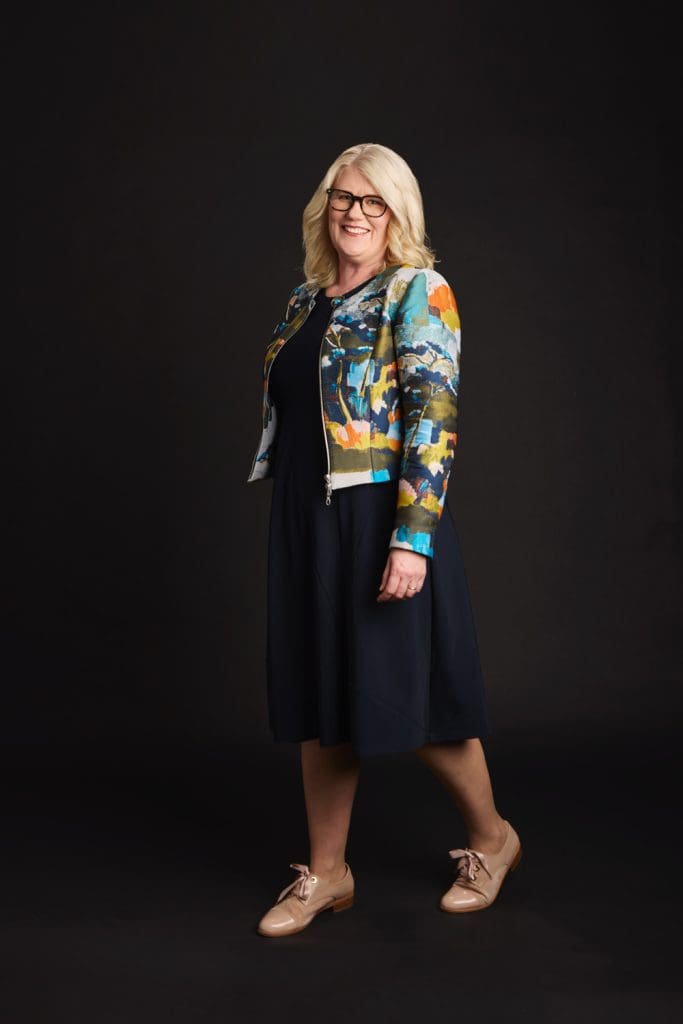
Fusion5 is a big ship. It began as a small Wellington venture and has grown into a trans-Tasman technology services company of around a thousand people. It implements core platforms, runs managed services, integrates data so decisions move faster, and is increasingly known for getting AI out of slide decks and into real work. “Nice, nimble, fast implementations, then a repeatable cadence of automation, process by process, team by team,” says Kristy Brown, who leads Fusion5’s New Zealand business. “Get the work out of slides and into people’s hands. Remove friction. Shorten cycles. Measure what matters.”
The scale is not the story by itself. The contrast is. Brown’s settings were built a long way from boardrooms. “I was born into a farm household in South Australia. I’m a late seventies baby,” she says. “It was a very messy start. That relationship was marred with alcoholism and violence. Not a safe environment.” Her mother left with three girls for a small coastal town on the New South Wales and Queensland border. “There was not a lot of social welfare back then. I still remember helping her pack tomatoes.” She remembers The Smith Family charity turning up with shoes when the school made footwear compulsory. She remembers Christmas arriving in a donated box. “My mum cried because the box had headless Barbie dolls. All broken. She thought that was going to be her answer to Christmas for her three girls.”
Inside the house, her mother tried to make order where there was none. “She would lay the table perfectly every night. Then we would reset it for breakfast. She tried to create normality while you were surrounded by chaos.” That habit became Brown’s operating model. “I’m okay being injected into a situation of chaos. That feels familiar. First you create calm. Then you create a high-performance team and culture.”
School was basic, but two switches flipped. “I got sent to a women in tech event. We played with technology for a day and even sent emails when it was still a green screen. That lit something up.” A science teacher then asked the class to own real projects. “We raised money, built greenhouses, restored dunes, and won a National Landcare Award in Sydney. It taught me there is no excuse. Pick a problem and do the work.”
Work started even earlier. “Within the first week at McDonald’s at the age of 13, well, 13 and nine months, I was almost 14, I started working forty hours. If I wanted to go on a school excursion, that was on me,” she says. “I became one of the youngest managers in Queensland. I was on the national super crew. And yes, I am the proud recipient of a Bachelor of Hamburgerology. It is a thing. I finished on the Dean’s List, the top nine percent.” The point is not novelty. It is muscle memory. “Put the uniform on and do the role. The real you can be shy in the change room. The person the customer needs turns up at the counter. That professional range still matters in leadership.”
Adulthood arrived with pressure. “I met my husband when he was eighteen and I was twenty. Within a few weeks we had the wonderful surprise of a baby.” Two weeks off work. No maternity pay. Then the crisis. “When he was four and a half months old, my son went into cardiac arrest. He was without oxygen for forty-five minutes. He was not expected to survive.” He did. “The next five years were about monitoring development and keeping a young family going.” Amidst this chaos, Kristy acquired a retail business, balancing entrepreneurship with motherhood. When the lease on the main store ended and the building was being demolished, they took an offer of family support and moved to New Zealand. “I liquidated stock and arrived in Dunedin with a ten-thousand-dollar bank cheque. Sliding-door moment.”
That moment opened a new chapter. A short temp role at PGG Wrightson led to accounts, then stream leadership on a large ERP, then a Business Performance role created for her to translate between operations and technology. “I realised I was fluent in two languages. What the business needs, and what the technology can do.” Sitting in a Fusion5 workshop, she saw it clearly. “I thought, holy moly, you do what I do. Maybe I should do that as a career.” After building practices and going through acquisitions, she returned to Fusion5 and today runs its New Zealand business at pace.
Her leadership playbook is compact. “Calm first. Then performance,” she says. “Write it down. Decide where the delay is. Fix the handover. Use an agent where it helps. Keep the human parts visible.” She is blunt about mindset. “Growth mindset is not a poster. After a miss, own your part, adjust, and move.” She is equally clear on sponsorship. “I have been the main earner for years. My husband runs his own business and his number one job is enabling me to be the best I can. No one judges a male CEO for that support. Why do we not celebrate the reverse. Treat support at home and at work as performance infrastructure.”
The same no-drama attitude shows up in how she talks about AI. Fusion5 turned itself into customer zero before selling anything to anyone else. “We often sign on customer paper. It is a massive job to review terms. One human can take forty to eighty hours just to digest a complex agreement,” she says. “Throwing more people at it wasn’t the answer.” The team built an internal agent. “Her name is Claire, our Contracting Legal AI Review Engine. You drop the file in Teams and leave her alone. She is grounded in a very clear knowledge base with very clear rules. She scans the agreements and gives you a summary report. Here’s what’s fine. Here are your medium-risk clauses. Here are your high-risk clauses. Our legal professionals go straight to what needs their brainpower.”
The impact was immediate. “We went from slow to ‘oh my God, you guys are amazing.’ We took a government engagement from terms to signature in three working days. That would have taken months before.” What matters is the pattern underneath. “Write out your business process. Where is it strained. Where are your delays and bottlenecks. Where are the risky handovers. That is just business analysis,” she says. “You do not need one agent to replace an entire business flow. The tech is not there yet and your humans are not ready for that yet. Target sub-tasks that remove bottlenecks.”
She is just as direct about adoption. “Tech readiness is only half the job. Human readiness matters just as much. If people do not feel safe or see the point, a proof of concept will fail.” Fusion5 pairs permission with expectation. “AI literacy is part of induction. Adoption is tracked. Licences follow usage. We are trying to give specialists time back, not run a science experiment.”
For customers, this inside-out credibility lowers risk. “Use your partner’s patterns. We can show you what we did to ourselves and what changed. That is how you move in weeks, not quarters,” she says. The scoreboard is simple. “Cycle time, error rates, handovers, customer feedback. Show me those metrics moving.”
Brown thinks New Zealand can punch above its weight in this phase. “We are brave and we can move fast when the value is clear,” she says. “The difference is the pace and trying to keep up with it. That is where a partner can help.” She sees the benefits of scale as both defensive and offensive. “Do the work so well that global competitors have no reason to be here. Then take your working patterns offshore.”
Asked what leaders should do now, she turns to a list that sounds like it came from the shop floor and the boardroom at once. “Start with the work, not the tool,” she says. “Map the process with the people who actually do it. Decide where an agent can create a better starting point. Run a short cycle. Measure the change. Keep what works. Drop what does not.” She pushes literacy over licences. “Teach people how to use the thing in their own work. If a tool is not being used, reclaim it and invest where there is pull.” She wants leaders to normalise sponsorship. “Build a support network for women earlier and more deliberately. Treat it as part of the operating model.” And she keeps a human rule at the centre. “Be present when the customer is stressed. Do the courageous conversation. Machines will not replace that.”
The origin story and the operating model are not separate threads. They are the same settings in different rooms. A kid who learned to make order at the dinner table now runs a company that makes order in complex organisations. A teenager who put on a uniform to perform a role now asks leaders to show professional range on cue. A young mother who made a sliding-door move to restart in New Zealand now asks customers to make short, deliberate moves that compound into transformation.