
The Kiwi Powerhouse: Driving The Global Glamping Phenomenon
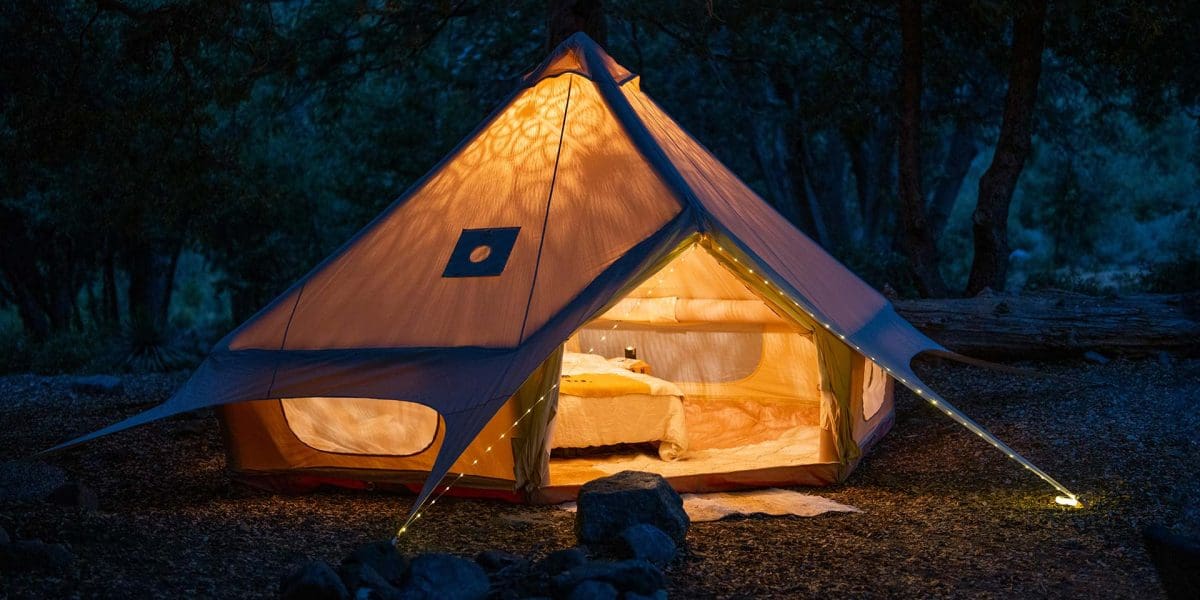
A decade ago, if you talked about sleeping in a tent, most people pictured damp scout camps, mystery stains on nylon and a deflating airbed at three in the morning. Today, the image is very different. Think fairy lights, proper beds, woven rugs underfoot and canvas walls glowing softly at sunset. Somewhere along the way, camping turned into glamping, and a whole new kind of outdoor lifestyle was born.
For a long time, that shift did not have a name or a face. It just seemed to appear in magazine shoots and festival galleries, fully formed. But if you follow the threads back through muddy UK fields, Californian canyons and the deep playa at Burning Man, you find the same signature tents cropping up again and again. Behind them is a quietly relentless New Zealander, now based in Byron Bay, who decided that temporary spaces could be as beautiful and considered as any home.
“I coined the phrase ‘tents for life, not the landfill’ back in those early festival days,” says Blue Bohemian founder Jessica Walsh. “It summed up my mission, to create tents people value, care for, and keep.”

Jessica started out on the UK festival circuit, watching fields fill up with cheap, one-weekend tents that would be abandoned by Sunday night. The waste was confronting.
“I remember standing in a muddy, rain-soaked festival field thinking, this cannot be it,” she says. Around her were piles of flimsy shelters that would not survive more than a single season. “That moment essentially became the spark for everything I built afterwards.”
A spark that has so far seen 15,000 customers around the world owning one of Jessica’s tents. “From families to luxury lodges, festival producers and high-profile clients.”
In the early days, glamping was still a niche. A handful of yurts and bell tents at boutique events, a few early adopters dressing their sites with vintage furniture and Moroccan lanterns. Jessica saw an opportunity to take that feeling and give it structure, design language and durability.
She ignored the standard advice to grow slowly and stay close to home. Instead, she aimed straight at the United States.
“I did not listen to any of the warnings about the US market,” she says. “I just backed myself and went for it. Looking back, that stubbornness was one of my greatest assets.”
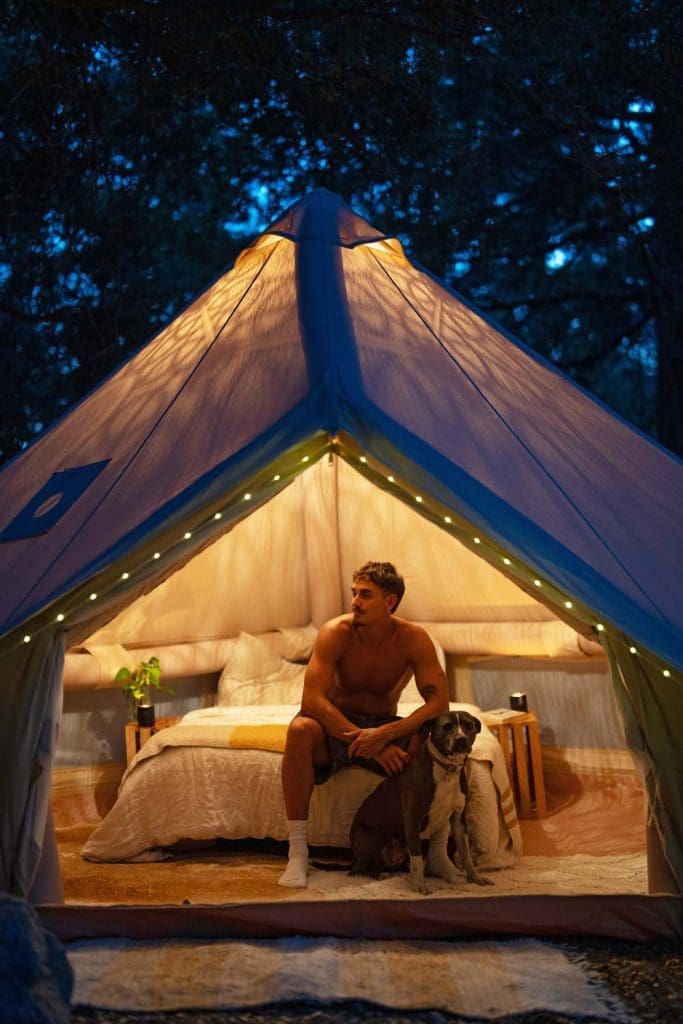
As glamping went global, so did her designs. At Burning Man, she walked out into the desert and saw her tents scattered from the city all the way to the deep playa, creating little villages of canvas. “When I went to Burning Man and saw my tents everywhere from the city to the deep playa, it felt surreal, like seeing your work take on a life of its own.”
There were quieter moments too, the kind that confirm you are part of something bigger than a product trend. “One of my favourite moments was a man pulling up beside me on the Golden Gate Bridge — I thought I’d cut him off,” she remembers. “He rolled down his window in traffic just to tell me he’d made a baby in one of my tents. It is still one of the wildest, sweetest compliments I have ever had.”
For a while, Jessica was based in Topanga Canyon in California, the hillside refuge for musicians, artists and dreamers that has its own mythology in film and music. Her tents sat in the yard, visible from the road. People would stop their cars and get out just to look.
“Topanga Canyon has always been this kind of magical place for bohemians, musicians and dreamers,” she says. “People would wander in just to ask what the tent was and where they could get one.”
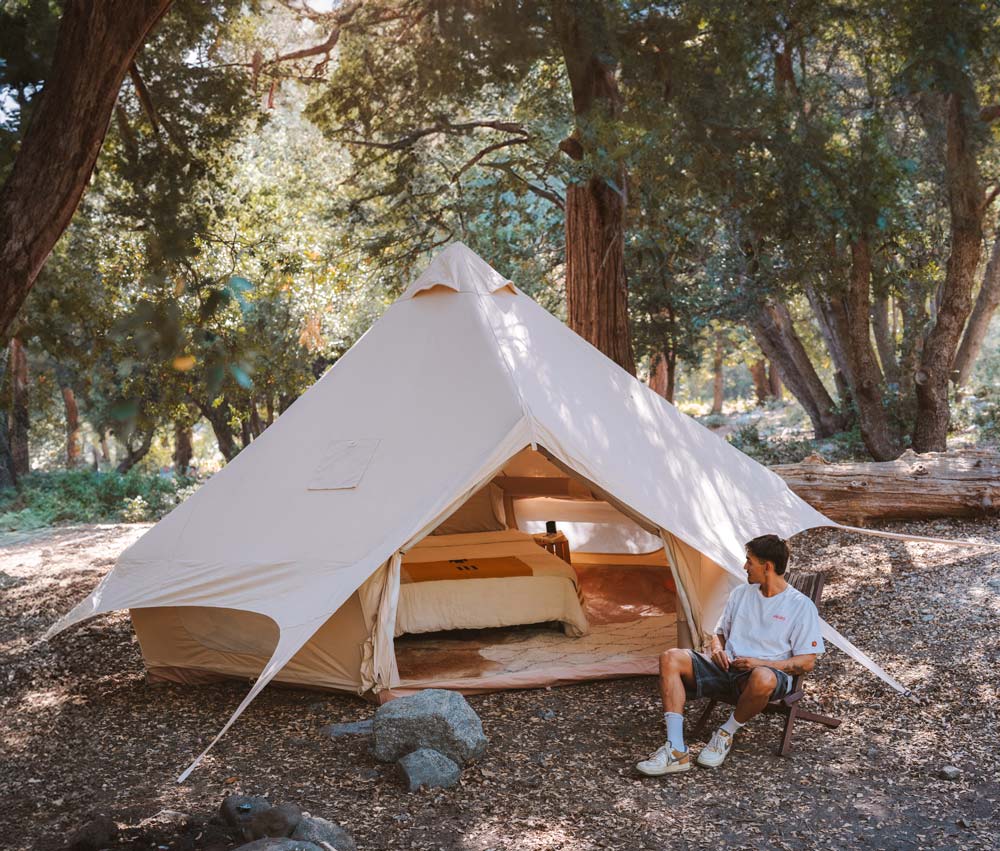
By then, glamping had moved from fringe experiment to a legitimate part of the travel industry. Luxury lodges wanted tented suites. Festivals were creating premium camping villages. Couples were getting married under canvas and families were booking glamping weekends instead of hotels. What had started as a reaction to waste had become an entire category of experience.
Then, like so many tourism stories, the upward curve collided with global reality. Tariffs, supply chain shocks and a pandemic hit the sector hard. For Jessica, one policy decision in particular was devastating.
“The Trump tariffs absolutely decimated my business,” she says. “At the time it was brutal, it felt like the rug had been pulled out from under me.”
This is the part of the story that often gets skipped in glossy profiles. Yet it is also where you see the mindset that drives both a founder and a movement like glamping, which has had to continually prove that it is more than a passing fad.
“The tariffs were awful, but they also forced me to rethink everything,” Jessica says. “You can let things tick along, or you can be challenged and evolve. I have always believed in being pushed to grow. It is uncomfortable, but it is where the breakthroughs happen.”
She is philosophical about the timing now. “Some of the best businesses in the world came out of tough times,” she says. “When something difficult hits, I try to remind myself that disruption can be a doorway. It forces you to rethink everything you thought you knew.”
For Jessica, that doorway led to a new base in Byron Bay, a baby daughter named Rumi, and a complete rebuild.\
“I rebuilt my entire company from the bones up with a newborn on my hip,” she says. “If that is not Kiwi grit, I do not know what is.”
As she started again, the glamping landscape she had helped create was also evolving. Guests were more discerning. Sustainability had shifted from nice to have to non-negotiable. Owners wanted structures that could work as hard as any small building while still packing up at the end of a season.
“Blue Bohemian is about creative freedom, better materials, and letting people experience the outdoors in a way that is both beautiful and sustainable,” Jessica says. It is her answer to where glamping goes next.
The new collection reads like a considered edit of everything she has learned from a decade in the field. The Better Bell Tent is a reimagining of the classic bell silhouette that launched a thousand glamping Pinterest boards. It is built from 100 percent breathable cotton canvas with reinforced seams and stress points, and a mesh and canvas wall system for airflow, so it feels as good on day three of a heatwave as it does on a cool evening. It is designed to be as at home at a high-end retreat as it is in a family backyard.
Then there is the one everyone keeps talking about, the Inflat-a-bell, Blue Bohemian’s inflatable bell tent.
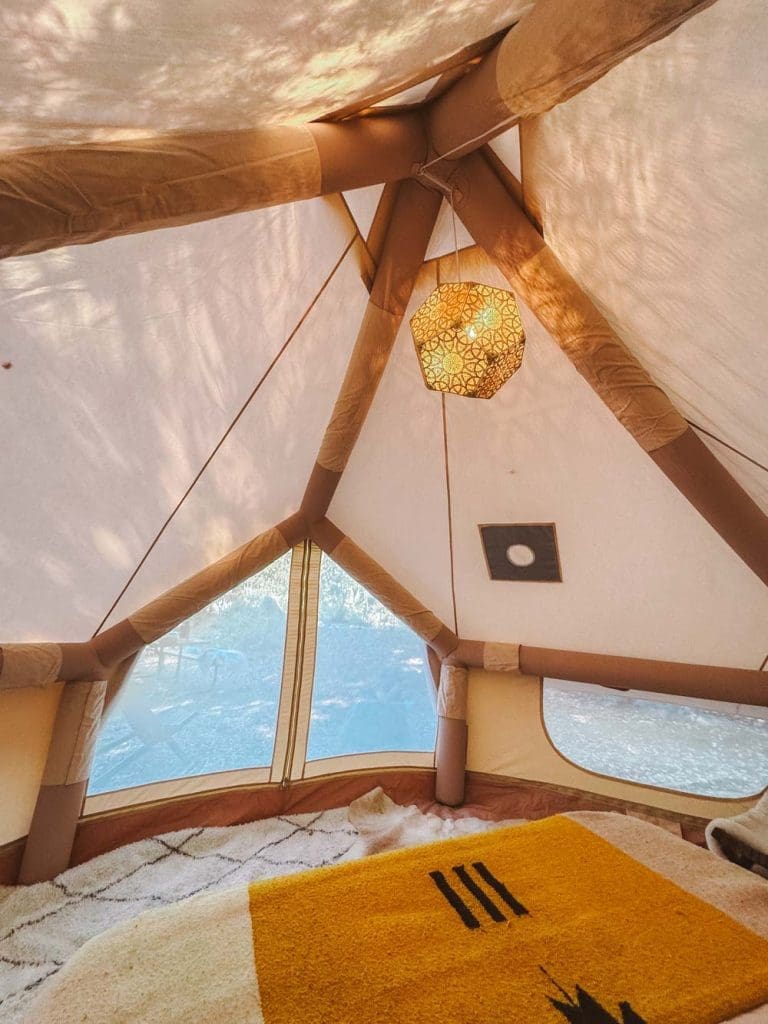
“The Inflat-a-bell feels like this lovely full circle moment for me,” Jessica says. “It is exactly the kind of innovation I wish I had at those early festivals.”
In pure glamping terms, it solves one of the trickiest pain points: set up. Traditional canvas tents are beautiful and robust, but they involve poles, ropes and a certain level of patience. The Inflat-a-bell uses an air beam structure that inflates in minutes. “Blue Bohemian’s inflatable tent range delivers festival level speed with premium materials,” she says. No wrestling with pole bags in the rain, no deciphering diagrams by head torch. You roll it out, plug in the pump and watch the structure rise.
Around the tents, Jessica is designing what she calls soft architecture for the outdoors. SolWing, a giant shade wing with a huge span and sculptural profile, can be used on its own or paired with tents to create full outdoor environments.
“I am excited to be designing again, and I have got some great innovations coming through,” she says. “SolWing is this gorgeous, sculptural canopy for creating instant outdoor living.”
It is easy to see how this fits into the broader glamping story. What began as a few pretty tents on the edge of festival fields has become a holistic approach to outdoor life. Canvas is no longer just a roof for sleeping. It is a way to carve out spaces for gathering, wellness, work and play.
“Every Blue Bohemian product reflects a belief that outdoor structures should be crafted, not consumed,” Jessica says. “I want tents that last, tents that inspire, and tents that are designed for life, not the landfill.”
In other words, glamping is growing up. It is less about props for photos and more about longevity, comfort and conscience. Guests want to know that the canvas above their heads has not been made to be thrown away in a few seasons. Owners want investments that pay their way year after year.
Alongside the design work, Jessica has become a bit of a guide for other entrepreneurs riding their own waves of change.
“When friends who run their own businesses started calling me for advice, I realised how much I had learned the hard way,” she says. She laughs about becoming the “camp counsellor” for founders, the person people ring when they have hit their limit. “If my experience can help someone else navigate their own journey, then that is a real privilege.”