
Danu Abeysuriya – Using AI To Make Yourself Irreplaceable
Danu Abeysuriya is the founder and CTO of Rush Digital. Under his technical leadership Rush has delivered large scale platforms and applied AI systems used by millions, including software used daily by one in ten New Zealanders. He is known for turning cutting edge research into practical products and for building cultures where people learn to pilot AI.
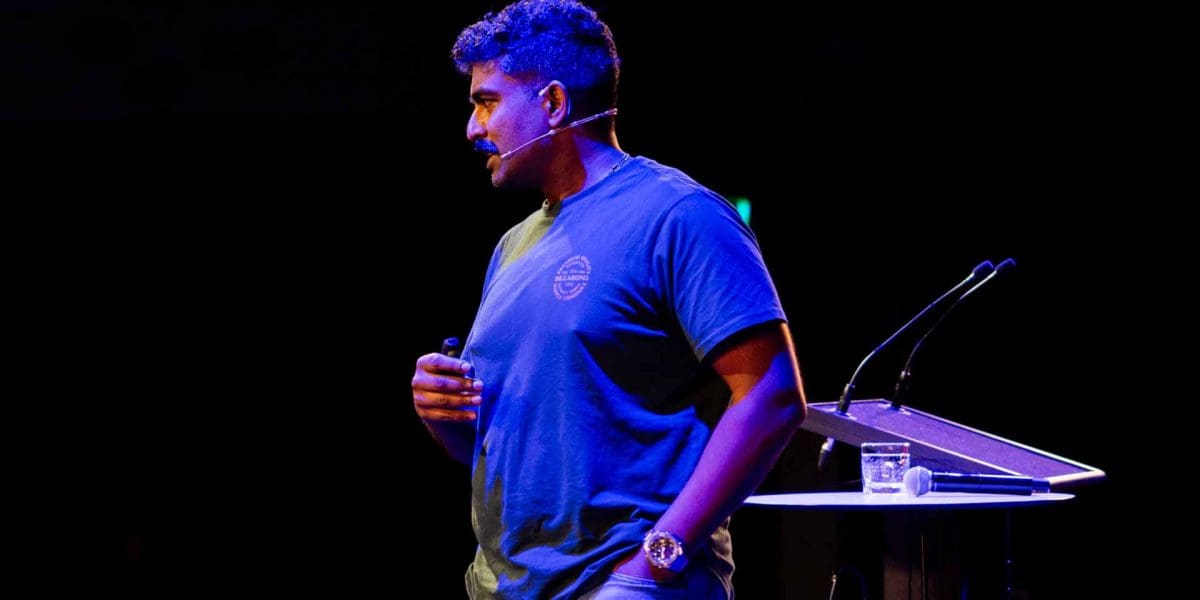
Danu jumps onto the stage and laments his place in the order. “I’m following a world champion and a high performance coach,” he laughs, “so I’ll keep the footwork light.” The joke sets a human tone before he gets to the point. Rush began in a garage. “Today, one in ten New Zealanders use software we build or operate.” The mission has not changed. “We design and build technology that better serves people.” The challenge is that generative AI can look like a threat to that promise unless leaders design for it. His throughline is practical and calm. “You do not have to be replaced. You can learn to pilot the tools.”
He frames the last two years as a test of posture. “We treated AI as an existential risk and an opportunity at the same time.” The team ran what he calls a crawl, walk, run transformation. “Crawl meant experiments and training.” No big claims, just hands on. “Walk meant systemising prompts, security, and quality controls.” He shrugs at the unglamorous work. “Run meant teams building assistants, piloting them, and then codifying what worked.” They measured. “Daily usage went from about 40 percent to about 95 percent.” Commercial results followed. “Revenue grew about 20 percent, headcount grew three to four percent.” His interpretation is simple. “People who learn to pilot assistants do more valuable work without burning out.”
To give the moment scale, he rewinds. “The first AI conference was in 1956.” Fraud detection has been running for decades. Compute has compounded for half a century. “We put a guidance computer on the moon, your phone is stronger, and the models read trillions of words.” He smiles at the contrast. “We put that power in our pockets and use it for Snapchat.” Then the turn. “The people who learn to pilot it will win.”
The most memorable story is about a person, not a platform. “Heather leads People and Performance at Rush.” Danu asked her to step into a sales oriented role and rebuild a managed services line around AI. “She had never been a salesperson. We made speed the constraint.” They asked a blunt question. “What if assistants could help her learn a new job in weeks instead of years.” Heather mapped the transition with prompts. “We took her current scope and drafted a crisp future scope.” She took formal courses, then distilled notes and collateral into a custom GPT. “It became a living coach.” She built task specific assistants for customer research, product research, pipeline hygiene, agenda design, and deal reviews. “The new line is humming, and we already acquired a small company into it.” He pauses so the point lands. “AI did not replace a role. It made a capable leader unstoppable in a new one.”
He draws the org chart of the near future in one sentence. “It is not people or AI, it is people piloting AI.” The practical move is to redraw your current chart. “Attach assistants and agents to roles, not to random individuals.” Then teach delegation like it matters. “Delete, defer, delegate to humans, or delegate to assistants.” He jokes about being told to wear pants on live TV after he turned up in shorts, and the room laughs. The subtext is intentional. “Humor lowers fear. Empathy keeps adoption high.”
Danu talks directly to careers. “Structured thinkers can cross borders.” He sees accountants and lawyers who can learn to code, and coders who can learn to sell. “Critical thinking transfers.” AI lowers the cost of trying. “You can try on the doing at a much lower cost now.” That is not a reason to freeze. “It is a reason to act.” He quotes futurist Frances Valintine on the widening gap between movers and laggards. “Find the blast radius of the next platform shift and get inside it.” That was true for the internet, for mobile, and now for AI. He does not worship speed for its own sake. “You can wait for perfect clarity or you can start lightly jogging.” The jog matters because compounding matters. “Early movers define standards and win advantages that are hard to catch.”
He is specific about where leverage shows up. “Do not ask which job a robot can do. Ask which job becomes a better human job when the assistant takes the grind away.” He lists work that can be offloaded. “Research, first drafts, meeting prep, QA passes, handover notes.” He returns to precision. “Do not build one assistant that does everything. Build narrow helpers that you can trust.” Prompts get the same treatment as processes. “If you do it twice, write it down. If you do it three times, make an assistant and share it.”
He keeps privacy, security, and fatigue in view. “Adopt with empathy.” Change needs a tone. “People first, equity and education, human language.” He suggests role playing hard conversations with an assistant. “Practice before it is live.” He pushes leaders to measure adoption and impact. “Track daily usage, time saved, quality lifts, and revenue per head.” The point is not a dashboard for its own sake. “What gets measured becomes culture.”
The simple daily tools still count. “Use Eisenhower’s matrix.” Delete what is noise, defer what is not urgent, delegate to humans, delegate to assistants. Put your strengths on the work that requires judgment and taste. He returns to the Heather story to close the loop. “We mapped the role change with prompts, built the assistants, turned training into tools, shipped fast.” None of it was magic. “The magic was in the posture. People first, assistants as leverage, measurement without drama.”
He finishes with a steady challenge. “Move now.” Not recklessly, but deliberately. “Start with experiments, systemise the wins, productise what works.” The last line is as human as the first. “Make AI additive. Ask which parts of your job become more human when the assistant takes the grunt work. Double down there. That is how you make yourself irreplaceable.”
Key takeaways you can use now
1. Treat AI as leverage by learning to pilot tools that multiply output and quality without multiplying hours.
2. Run a crawl, walk, run adoption plan that starts with experiments, moves to standardised prompts and controls, then productises what works.
3. Redraw your org chart with role based assistants attached to people so AI support is designed, not accidental.
4. Teach delegation explicitly with a delete, defer, delegate to humans, or delegate to assistants framework.
5. Build narrow, task specific assistants for research, drafting, agenda design, QA, and handover so trust and quality stay high.
6. Map role changes with prompts that draft scope, responsibilities, and 30, 60, 90 day milestones, then iterate with a mentor.
7. Turn training into tools by distilling course notes and internal collateral into custom GPTs that capture how you work here.
8. Measure adoption and impact with daily usage, time saved, quality lifts, and revenue per head so wins become culture.
9. Keep humans at the center by checking privacy, security, and change fatigue, and by using humor and empathy to lower fear.
10. Use simple prioritisation like Eisenhower’s matrix to clear noise and focus assistants on high value tasks.
11. Role play hard conversations with an assistant to test approaches and reduce risk before live moments.
12. Cross skill with confidence because critical thinking transfers across functions and AI lowers the cost of trying.
13. Move early and steadily since compounding favors early adopters who define standards and earn durable advantages.
14. Aim yourself at the blast radius of platform shifts such as AI to increase exposure to opportunity.
15. Ask which parts of the job become more human when assistants take the grind, then double down on those human strengths.