
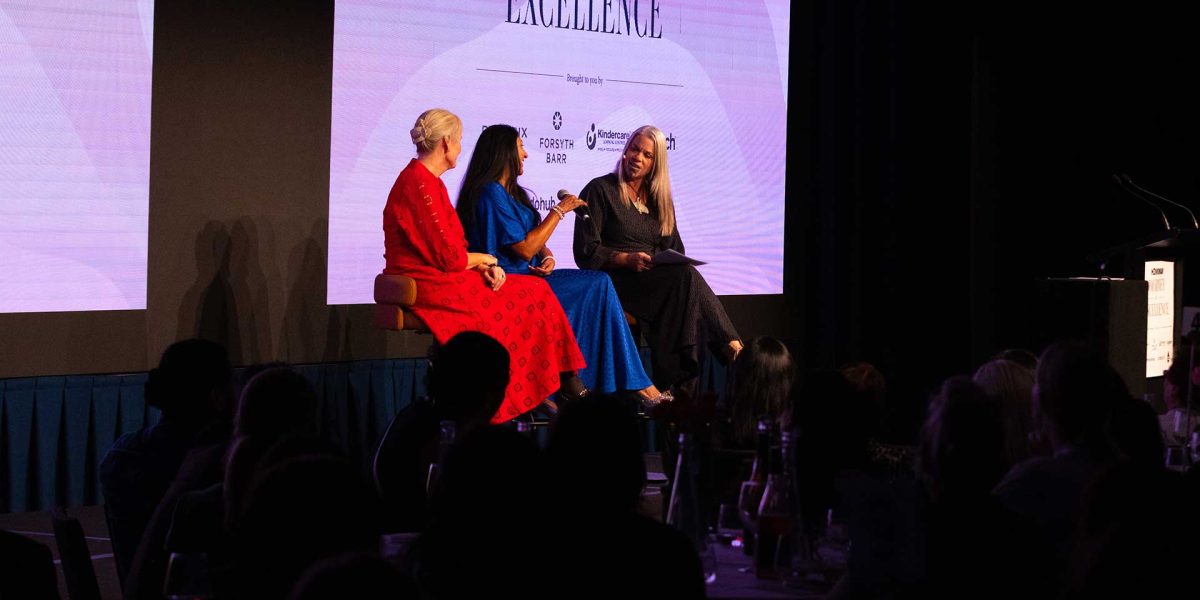
Imposter Syndrome, Mothers, Motorbikes and Steak
The day closed with Miraka Davies back in the MC chair, steering Sita Proud and Rosanne Graham through a conversation ranging from feedback and imposter syndrome to mothers, motorbikes and steak.
Asked what had stuck with her from the day, Proud pointed to Andrew Nicol’s letter to his children. “I’m gonna write my boys, all three of them, they’re 15, 12, and seven. I’ve gotta bring good men into this world to support the cause.” Graham’s answer was the room itself: “The generosity of women to share their stories. There’s a real power in being authentic and being yourself. We’re not robots, we’re people.” She also admitted the AI session had left her “a bit intimidated. I’m down in the low curve. Got a bit of work to do.”
On standing at the edge of something scary, Proud, a brain injury survivor, wished someone had told her “that I was still going to be alive, and that I’m going to be okay, and I could still be who I am today. Slightly different version.” Davies added the process she raised her daughters on: ask what the worst that could happen is, whether you could live with it and come back from it. If so, “there’s no reason not to go ahead and do the brave and scary thing.”
Graham brought in a story about truth-telling, from her days in Parliament’s opposition research unit when National was led by Jim Bolger. On the campaign trail, Bolger gave a speech so off-piste that “he ended up talking about communists and all sorts of really nutty stuff”. Back in his office, surrounded by senior staff, he asked how the speech went. Everyone told him he was really good. Graham, about to say otherwise, received a warning elbow from her boss. “All the media the next day said he was terrible. But nobody in the room wanted to tell him.” Nobody needed to be brutal; a gentle steer would have done. The lesson has stayed with her. “You are not better when people tell you you are good when you are not. The more senior you get, the more at risk you are of thinking that you know it all and you just don’t.”
Both panellists endorsed feedback as fuel, with caveats. “That’s the only way you’re going to ever grow,” Proud said, though she stressed weighing the giver’s intent and building “a good group of women, a diverse group of people that have different backgrounds” as “a safe psychological environment to be vulnerable and learn”. Davies added the filter she teaches as a plain language trainer: ask who the critic is and whether you respect them, because too many people carry one throwaway comment as truth forever, softening their writing because someone once called them blunt. “If it’s someone you respect 100 per cent, go home, cry. And then think about where it’s coming from and take it on board, because that’s how we grow.”
Then there was the feedback worth binning. Davies offered being called intimidating: “That is a you problem, that you feel intimidated by me, and I am not going to make myself smaller to make you comfortable.” Proud has been told she is too loud “and that I need to calm down a bit because people think I’m always drunk”. At 9am. Her verdict: “This is me, tough.” Graham said the only advice she reliably rejects is being told to stop worrying about people and move on. “I’d rather be in an organisation where the leaders did care and did worry and did fret at times about things.”
Imposter syndrome got an airing. Graham confessed to feeling it that very week (“Who’s going to care?”) and recalled a man who ran Europe’s largest public relations firm telling her he would look in the bathroom mirror and think, this is a joke, how am I doing this? Her conclusion: “It doesn’t mean because you think it, that it’s true.” Proud revealed the keynote she had just delivered was her first, prepared in a week. Davies supplied the reframe: she once read that imposter syndrome correlates with high achievement and intelligence, “so every time I feel it, I go, oh look, there is the confirmation of how smart I am.”
The final question, a woman who shaped you, drew the warmest answers. Proud chose her mother, “a bit nuts, but I love her”, who learned English and put herself through college while raising two girls alone. Graham declined to nominate anyone: “I don’t put anybody on a pedestal, really, but I put some of the things they do on a pedestal.” She admires traits, drawn from grandmothers, girlfriends and male mentors alike, because “we’re all very human, we’re all fallible, and none of us have got it all together.”
Key Takeaways
1. Keep truth-tellers close. Graham’s Bolger story is a warning: seniority attracts flattery. You are not better when people tell you you are good when you are not, so build a circle that will say so.
2. Filter feedback by source. Ask who this person is in your world and whether you respect them before you carry their opinion for the rest of your career. Weigh the intent behind it, then decide how much power it gets.
3. A thought is not a truth. Imposter syndrome visits everyone, including people running Europe’s largest firms. Feeling like a fraud is not evidence that you are one; take a breath and push on through.
4. Some feedback is a you problem. Too loud, too intimidating, too much: sometimes the critique says more about the critic. You are not obliged to make yourself smaller for anyone’s comfort.
5. Run the worst-case process. Before the brave and scary thing, ask what the worst outcome is and whether you could live with it. If you can come back from it, there is no reason not to go ahead.