
Book Review: The Molecule We Can’t Live With, and Can’t Live Without
Carbon dioxide is both a planetary threat and a driving force behind life on Earth, according to author Peter Brannen. Carbon dioxide has a terrible reputation. It’s much maligned because of its role as a biosphere-threatening pollutant, but in fact the atmospheric compound has been a critical driving force behind the creation of life on Earth, shaping human history and the waves of evolution preceding it.
Peter Brannen’s new book, “The Story of CO2 is the Story of Everything: How Carbon Dioxide Made Our World,” is just what the title promises, drawing on geology, thermodynamics, chemistry, biology, and eventually, economics and sociology to make his case. “Four billion years ago, CO2 came alive,” he writes. “It remains the ultimate source of carbon for all life, the primary knob of Earth’s temperature, and our species’ signature product.”
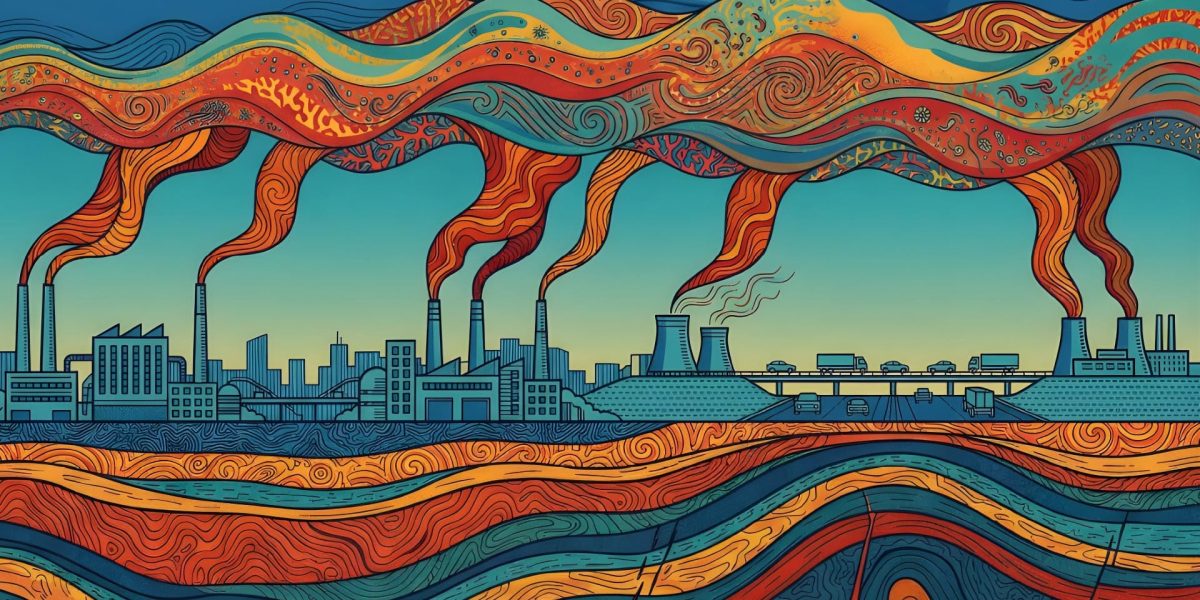
The pivotal part of the tale begins hundreds of millions of years ago when photosynthetic energy in the form of early plant life, algae, and bacteria became buried within the Earth’s crust, eventually forming fossil fuels. Those deposits were uncorked eons later by England’s industrial capitalism, and more than a century after that, by multinational fossil-fuel corporations, creating a thickening blanket of atmospheric CO2 and detonating today’s perilous carbon bomb.
One might argue that the history of life revolves around O2 (oxygen) and H2O (water) as much as CO2. But though the buildup of oxygen in the atmosphere enabled complex life, Brannen shows that the gas wasn’t primarily created by photosynthesis but by longtime geologic processes, which naturally involve CO2. And to Brannen, water is merely an assistant, helping to transform carbon dioxide from the air into the stuff of life. So carbon dioxide, he convincingly shows, is the real star of the show.
Brannen, the author of “The Ends of the World,” a 2017 account of Earth’s five mass extinction events, is also a contributing writer at The Atlantic, where he has taken on scientifically contentious issues, like whether we’re living in the Anthropocene or not, or refuting the idea that the Amazon is the Earth’s lungs. In his latest book, he wades into other provocative debates, such as whether or not Earth is really facing a sixth major mass extinction, but he fully acknowledges that humanity’s carbon dioxide emissions are propelling us toward such a catastrophe.
Before assessing how the planet became so imperiled, though, he examines the probable origins of life. Brannen explores two leading hypotheses: that it began with “metabolism first” — with chemical reactions at deep-sea hydrothermal vents that didn’t require photosynthesis — or with “information first,” in which a soup of RNA-like molecules began replicating and eventually produced proto-cells. The jury is still out on this debate, though Brannen leans toward the metabolism idea, making the provocative suggestion that “perhaps the first life wasn’t a miracle, but a necessity” to resolve chemical instabilities at those marine vents.
In chronicling how Earth reached today’s climatic tipping point, Brannen takes a lively tour of past eras, when the planet wildly swung between snowball Earth and greenhouse Earth. The former resulted from a dearth of carbon dioxide and a layer of ice encasing the planet, while the latter came from an overabundance of atmospheric carbon, dramatically raising temperatures. (Venus, where a runaway greenhouse effect made that world uninhabitable around a billion years ago, serves as a warning, he writes.)
It’s always been a tenuous balance, Brannen writes: “In recent geologic history, for instance, when CO2 has varied between 0.1 percent and 0.018 percent of the atmosphere, it has been the difference between alligators in the Arctic Circle on the one hand, and an Antarctica’s worth of ice burying North America on the other.” (It’s about 0.04 percent today.)
Brannen also argues that, despite a devastating asteroid impact being responsible for the last mass extinction some 65 million years ago, most environmental catastrophes have been caused by climatic changes, such as a gigantic series of volcanic eruptions disrupting the carbon cycle at the end of the Permian period about 252 million years ago.
The Earth and the biosphere have proven resilient until now, but Brannen points out that humanity is now dangerously transferring carbon dioxide from the crust to the atmosphere more efficiently than volcanoes ever could. He traces the early expansion of fossil-fuel powered capitalism throughout the British Empire, along with the colonial ambitions of the Dutch, Spanish, and later, Americans. He also documents the role of fossil fuels in more recent geopolitical conflicts and coups in places like Iran, Egypt, Saudi Arabia, and Venezuela.Brannen is generally more comfortable writing about geological history than economic and sociological forces, and his depictions of geochemical and chemical processes over the eons are particularly vivid. For example, when depicting the otherworldly Archaean Earth, which spanned from around 2.5 to 4 billion years ago, he writes: “Suffocating oceans tinted an uncanny green — not with seaweed and blooms of plankton, but with iron — sprayed pink skies with methane-drenched surf. Islands of rock now breached this surf and hosted empty rivers coursing over dead land.” With such eloquent descriptions, he manages to bring the nearly lifeless planet to life.
Brannen is wary of what he calls the “bugaboo of environmental determinism” when evaluating the trajectory of human societies and civilizations, and he makes the critical point that “the answers to climate change are not to be found in the realm of atmospheric physics or geochemistry. They are political and economic.”
At the same time, however, he asserts that “understanding the sensitivity of the planet to carbon dioxide in its geologic past is key to understanding our climate future.”
Every climate change book eventually must ask: What comes next? For the most part, Brannen leaves it to the reader to determine whether the future could deliver a “buzzer-beating technological miracle, a startling transformation of the political economy of the developed world, a ruinously tardy and incremental market-led energy transition, or failing all that, corrective planetary catastrophe.”
Nevertheless, he has thoughts on the matter. Brannen argues that carbon removal technologies, like expensive machines that suck carbon out of the air, are insufficient to the titanic task, and that banking on solar geoengineering approaches like large-scale rock weathering is a risky endeavor.
He also points out that despite “endless corporate cheerleading about the clean energy transition,” fossil fuel production since 2000 has merely dropped from 86 percent to 82 percent of global energy in 2023. Fossil fuels need to be left in the Earth, he argues, but capitalism impels corporations to avoid abandoning trillions of dollars of buried profits. And with abundant fracking and tar sands, “peak oil” might not have arrived yet.
Brannan’s book arrives amid a flurry of climate-related titles this year, including Malcolm Harris’ “What’s Left,” a future-looking take on the prospects for collective action addressing the climate crisis, and Thea Riofrancos’ “Extraction,” an analysis of the environmental and social costs of the current clean-energy transition, which also offers an alternative vision. But his account is more closely related to Michael E. Mann’s 2023 book “Our Fragile Moment,” which includes a more detailed account of climatic history over the past few million years, intended to combat persistent climate denialism.
This is an ambitious and urgent addition to this growing collection, evocatively demonstrating how humanity’s history and precarious future has been continually connected with Earth’s much longer geochemical history. Despite the troubling climate trends evident today, he ultimately seeks some reasons for hope, arriving at a Carl Sagan-like farsighted, sanguine view of humanity’s future. “Humans can be warlike, shortsighted, provincial, and stupid,” he writes, “but our species is also uniquely capable of collaboration, learning, ingenuity, and adaptation.”